
Flood damage restoration in Greenville: calls answered 24/7
Book flood damage restoration in Greenville by phone, day or night.
In Greenville's ZIP codes, the average building payment on a flood claim was $25,791 over 2016 to 2025, compared with $33,376 across South Carolina.
- Calls answered 24/7
- Written estimate before work starts
- Water removal, drying and repair
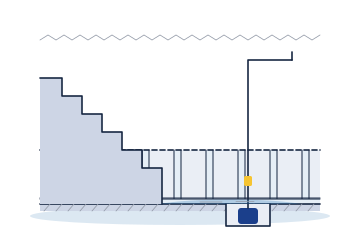
One of six water jobs booked in the Greenville area with one call.
59% of homes in Greenville are rented, against 31% across Greenville County. If you rent, tell your landlord or property manager about the leak right away.
Flood Damage Restoration in Greenville
Flood damage restoration in Greenville covers water from outside: storm runoff, groundwater through basement walls and failed sump pumps. Floodwater is treated as contaminated, so soaked porous materials come out before drying.
Outside floodwater is treated as Category 3 water under the IICRC S500 standard because it carries soil, chemicals and bacteria. Porous materials it touched, such as carpet, pad, insulation and drywall below the water line, are removed rather than dried, and hard surfaces are cleaned and disinfected.
The S500 Consensus Body noted in February 2026 that wind-driven rain and roof leaks are not automatically Category 3; the restorer decides from site conditions. That decision changes the scope and the price, so ask how the category was set.
- Pumping out flooded basements and crawl spaces
- Removing mud and debris
- Tear-out of drywall, insulation, carpet and pad below the water line
- Cleaning and disinfecting hard surfaces
- Structural drying and moisture readings
- Documentation for a flood insurance claim
Greenville and flood damage restoration
Greenville has far more shared housing than the county around it. Census figures show 42% of homes are in buildings with 5 or more units, against 16% for Greenville County, and 59% are rented. In a flood, ground-floor and lower-level units take the water first. Each building may involve a landlord, an association and many tenants.
The older parts of the city add risk. About 12% of homes were built before 1950, against 6% for the state, and 42% before 1980. Older homes often sit over crawlspaces or basements, where storm water pools and soaks insulation and floor framing.
Rain drives most flooding here. NOAA climate normals show 14 days a year in Greenville with an inch of rain or more. National Weather Service storm reports count 11 days with flash flood or flood reports in the county between 2016 and 2025. FEMA disaster declarations for floods and storms in the county number 9 since 2000. FEMA flood insurance records show 1.5 claims per 1,000 homes in the city, above the county's 1.2.
On a flood call, the restoration crew checks first where the water came in and what it carried. Outside flood water is Category 3. Soaked carpet, pad, insulation and the lower drywall are usually removed, not dried in place. In apartments, the crew checks every affected unit and the walls between them. Then it dries the structure and logs readings each visit.
Ask the crew to name the water category and show the first moisture readings. Ask how often readings will be logged, what will be removed and why. Ask for all of it in writing, as an estimate, before rebuilding. Only 0.6% of county homes carry federal flood insurance, per FEMA records, so tenants should check renter's cover and owners their flood policy. Neighbors seeking flood damage restoration in Greer or across the Greenville area face the same questions, and sewage cleanup is needed if drains backed up.
Flood damage restoration in Greenville, job by job
Flooded basement cleanup
Pump-out, mud removal, tear-out below the water line, disinfection and drying of basement walls and floors.
Storm water cleanup
Water from heavy rain that came in at doors, window wells or low points is extracted and the area dried.
Crawl space water removal
Standing water under the house is pumped out and the crawl space dried so moisture does not move into the floor above.
Sump pump failure cleanup
After a power outage or pump failure, the basement is pumped out, cleaned and dried, and the pump problem is noted for repair.
Greenville in figures
Figures for Greenville, home to about 71,755 people.
42% of homes in Greenville are in buildings with five or more units.
FEMA's National Risk Index expects inland flooding to cost about $73 a year for every $100,000 of building value in Greenville's ZIP codes.
- 59% Homes that are rentedGreenville County: 31%
- 42% Homes in buildings with 5 or more unitsGreenville County: 16%
- 38,545 Housing units
- 71,755 Residents
- 73 Yearly inland flood loss per $100,000 of building valueGreenville County: 86
- 1% Mobile and manufactured homesGreenville County: 8%
Sources: U.S. Census Bureau, American Community Survey 2019-2023 5-year estimates; FEMA OpenFEMA, FIMA NFIP Redacted Claims v3, claims from 2016 to 2025 (not endorsed by FEMA); FEMA OpenFEMA, NFIP Residential Penetration Rates v1 (not endorsed by FEMA); FEMA National Risk Index v1.20, December 2025 (not endorsed by FEMA); NOAA NCEI, U.S. Climate Normals 1991-2020, nearest weather station; FEMA OpenFEMA, Disaster Declarations Summaries v2 (not endorsed by FEMA); NOAA NCEI Storm Events Database, 2016 to 2025.
What moves a Greenville estimate
- Depth of the water and the area of the basement or floor.
- Mud and debris removal.
- How much drywall, insulation and flooring sat below the water line.
- Disinfection of Category 3 water.
- Drying days.
Related jobs in Greenville
-
Burst Pipe Water Damage Cleanup
Pipes in exterior walls, attics and crawl spaces of Greenville homes fail first on hard freezes; ask about what burst pipe cleanup covers in Greenville.
Call for Burst Pipe Cleanup -
Emergency Water Removal and Extraction
Standing water on a Greenville floor, in a kitchen or a basement comes out first, before anything can dry; ask about Greenville water removal.
Call for Emergency Water Removal & Extraction -
Water Mitigation and Drying
Air movers, dehumidifiers and moisture readings until the job meets a dry standard: for Greenville, ask about water mitigation in Greenville.
Call for Water Mitigation & Drying -
Water Damage Repair
Once a Greenville home tests dry, the walls, floors and ceilings that came out go back in; ask about water damage repair for the Greenville area.
Call for Water Damage Repair -
Sewage Cleanup
Containment, removal, disinfection and drying: for a backup in Greenville, ask about what sewage cleanup covers in Greenville.
Call for Sewage Cleanup
Where flood damage restoration calls come from near Greenville
Guides for Greenville
the Greenville guide to insurance and water damage
Which kinds of water damage insurance usually pays for in Greenville, and how to document a claim.
Greenville guide to flood and storm water risk
Flood risk, flood insurance claims and storm water in Greenville, from FEMA and NOAA figures.
Greenville water damage cost guide
Price ranges, cost drivers and estimate checks for Greenville homes.
guide to the first hour after water damage for Greenville
The first hour after a leak or flood in Greenville: what to shut off, what to photograph and what to move.
guide to burst and frozen pipes around Greenville
Why pipes burst in Greenville homes, what freezing nights and older plumbing mean, and what to do first.
What flood damage restoration costs in Greenville
Typical ranges from published cost guides, not quotes.
| Item | Typical range | Unit |
|---|---|---|
| Floodwater cleanup and drying (outside water is Category 3) | $7 to $12 | per sq ft |
| Flooded basement cleanup, 500 to 1,000 sq ft | $2,000 to $8,000 | per job |
| Basement water removal, drying and sanitizing | $4 to $12 | per sq ft |
Typical US ranges compiled on 17 October 2026 from public cost guides and price lists, not prices from 911 Water Damage Fix or any one company. Most guide figures trace back to Angi and HomeAdvisor customer surveys (HomeAdvisor water damage cost guide, updated June 17, 2026); independent checks: HomeGuide (2025 and 2026), Fixr (January 2025), a State of Iowa restoration contract price list effective May 22, 2026, and a published restoration equipment rental list. The written estimate after an inspection is the only price that applies.
What Greenville callers ask about flood damage restoration
Is floodwater dangerous?
How much does flooded basement cleanup cost?
Does insurance cover a flooded basement?
Do you take water damage calls in Greenville?
How soon can a crew get to Greenville?
Are older homes in Greenville more likely to have water damage?
Water damage in Greenville? Call (833) 728-2327
Day or night, the call is answered, and the price is written down first.