
Why pipes burst in Greenville homes
For Greenville, SC: the facts behind the questions callers ask most, in plain words.
Building payments on flood claims in Greenville's ZIP codes averaged $25,791 in the ten years to 2025.
- Calls answered 24/7
- Written estimate before work starts
- Water removal, drying and repair
From your call to a written estimate
Call (833) 728-2327
Tell the person who answers what got wet and where the water came from. Calls are answered 24/7.
Stop the source
You get help shutting off the water or the power to a wet room while the crew is on the way.
Inspection and written estimate
Moisture readings, photos and a written estimate come before any work begins.
A guide for water damage restoration in Greenville and the towns around it.
Renters live in 59% of the homes in Greenville, compared with 29% across South Carolina.
What breaks pipes in Greenville
Greenville freezes more often than South Carolina as a whole. NOAA's climate normals record 64 nights a year at or below 32 degrees, against 49 for the state. The city also has 8 nights at or below 20. On those nights, pipes in crawl spaces, exterior walls and attics can freeze, and the split shows once the ice thaws. Before a night at or below 20 degrees, open the cabinet under any sink on an outside wall and close the crawl space vents.
Census figures show 42% of homes were built before 1980 and 12% before 1950. Older bungalows often have galvanized lines and valves that stick. Newer apartments bring their own risks, since 42% of homes are in buildings with 5 or more units. A burst line upstairs travels down. Water heaters and washer hoses fail in both kinds of building. If an old valve sticks, have it replaced before winter so it will close when you need it.
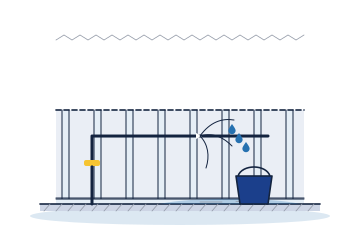
When a pipe bursts, close the main shutoff and tell the landlord or manager, since 59% of homes are rented. Open the lowest faucet to drain the lines, switch off breakers in wet rooms and photograph what you see. Then phone for burst pipe cleanup, day or night. In an apartment, check the unit below as well, because water often reaches the carpet there. Wet carpet drying should start just as soon.
What burst pipe cleanup costs
Typical US ranges from published cost guides (HomeGuide, HomeAdvisor, Fixr, 2025 to 2026), not quotes.
| Item | Typical range | Unit |
|---|---|---|
| Burst pipe repair, plumbing only | $400 to $2,000 | per repair |
| Burst pipe repair with related water damage | $1,000 to $4,000 | per job |
| Water removal and drying, clean water | $3 to $6 | per sq ft |
| Air mover on site | $29 to $40 | per unit, per day |
| After-hours, weekend or holiday charge | $50 to $500 | per visit |
Greenville figures behind burst pipes
Greenville figures: about 71,755 residents in the city, by the Census.
42% of homes in Greenville share a building with at least four other units, against 16% across Greenville County. In a shared building, let the manager and the neighbors below know about a leak.
By FEMA's estimate, inland flooding costs homes and businesses in Greenville's ZIP codes about $73 a year per $100,000 of building value.
- 59% Homes that are rentedGreenville County: 31%
- 42% Homes in buildings with 5 or more unitsGreenville County: 16%
- 38,545 Housing units
- 71,755 Residents
- 73 Yearly inland flood loss per $100,000 of building valueGreenville County: 86
- 1% Mobile and manufactured homesGreenville County: 8%
Sources: U.S. Census Bureau, American Community Survey 2019-2023 5-year estimates; FEMA OpenFEMA, FIMA NFIP Redacted Claims v3, claims from 2016 to 2025 (not endorsed by FEMA); FEMA OpenFEMA, NFIP Residential Penetration Rates v1 (not endorsed by FEMA); FEMA National Risk Index v1.20, December 2025 (not endorsed by FEMA); NOAA NCEI, U.S. Climate Normals 1991-2020, nearest weather station; FEMA OpenFEMA, Disaster Declarations Summaries v2 (not endorsed by FEMA); NOAA NCEI Storm Events Database, 2016 to 2025.
Prevention in Greenville
Homes in the Greenville area get 64 freezing nights a year, against 49 for South Carolina as a whole. They need more winter care than many in the state. Wrap exposed pipes in crawl spaces, attics and exterior walls, close foundation vents for winter and seal drafts around pipe openings. Disconnect garden hoses and cover outdoor faucets. On the 8 nights a year at or below 20 degrees, open sink cabinets on outside walls and let a faucet drip. Keep the heat on if you travel.
Renters hold 59% of Greenville homes, and 17% of households moved in since 2021. If you are new, ask the landlord where the main shutoff is and check that it turns. Landlords should insulate exposed lines before the first freeze and replace water heaters with rust at the base. Tenants should also know who to call after hours. A burst line on a weekend night can run a long time before anyone shuts it off.
Older homes, the 42% built before 1980, need their supply lines checked for corrosion and their rubber washer hoses swapped for braided steel. In apartment buildings, report a damp ceiling the day you see it, and keep any upstairs water heater in a drain pan. If a pipe does fail upstairs, ask the restoration crew about water-stained ceiling repair in the unit below.
Know your shutoff in Greenville
The main shutoff is usually where the water line enters the house: on a basement or crawl space wall facing the street, in a garage, in a utility closet or next to the water heater. In warm climates it is often outside, near the foundation or in a box at the curb. Find it now, turn it off and on once to make sure it moves, and tag it so anyone in the house can find it. A burst pipe can release several gallons a minute, so the minutes saved by knowing the valve matter more than anything else. A pipe that splits above a ceiling often ends with ceiling water damage repair once the framing is dry.
Greenville pipe questions
At what temperature do pipes freeze?
How do I stop pipes from bursting in Greenville?
What does a burst pipe cost to clean up in Greenville?
What should I do first when a pipe bursts in Greenville?
How do I know if a pipe is leaking inside a wall in Greenville?
Related Greenville guides
guide to water damage costs around Greenville
What water damage restoration costs around Greenville, what moves the price and what the estimate should list.
Greenville water damage insurance guide
Homeowners, flood and sewer backup cover explained for Greenville.
first steps guide around Greenville
A step-by-step first hour for Greenville homes with water damage.
flood risk guide around Greenville
How often water from outside reaches Greenville homes, and what to do about it.
Calls answered 24/7 around Greenville
Answered 24/7, with a written estimate before any work starts.